


U.S. Air Force basic trainees receive their initial gear, including athletic shoes, at Joint Base San Antonio-Lackland, Texas, in February 2019. (Sarayuth Pinthong/U.S. Air Force)


(Tribune News Service) — In their bright orange junior ROTC shirts, Air Academy High School students pushed each other to do as many situps as possible on a breezy fall day in October.
It was a workout that followed a good-natured game of kickball and one that helps prepare students who are interested for their military fitness tests, should they choose to enlist or commission.
While not formal recruiting programs, JROTC and the high schools that host them are important pools of potential troops for the military. When the pandemic shuttered schools, recruiters blamed limited access to students in part for the branches’ inability to meet their recruiting goals.
However, it’s a source of recruits that has started to shrink nationally, with the number of young people turning 18 each year in the United States expected to fall through 2041. It’s a demographic shift that started during the Great Recession when families started having fewer children.
The Western Interstate Commission for Higher Education estimates the number of high school graduates will decline from 3.9 million nationally in 2025 to 3.4 million in 2041.
At the same time, the Army estimates only 29% of American youth are eligible to serve. Obesity, drug use, physical and mental health problems, among other issues, make most of the nation’s young people ineligible.
Still, after a few years of lackluster recruiting numbers, the Air Force and Army have met their goals early two years in a row, allowing them to send new recruits to their delayed entry programs. The Space Force never had a problem with recruiting, in part because it is so small.
Secretary of Defense Pete Hegseth celebrated the recruiting wins across the military branches when he visited the Air Force Academy in early October ahead of the Air Force versus Navy football game.
Hegseth was on the Send Me tour, intended to encourage young people to join.
“Recruiting in the United States military at the Department of War is at decades-long records,” he said.
He attributed the success to a return to the military’s elimination of diversity, equity and inclusion programs and focus on merit-based leadership
However, when it comes to recruiting, numerous factors play a role, including the job market, said Jennifer Heissel, a senior economist at Rand, a nonprofit think tank.
Youth unemployment rose over the last two years from a low of 6.6% in April 2023 to 10.6% last November.
After falling to 8.5% in March, it was up to 9.9% as of September, according to federal data. Youth unemployment typically runs higher than the rate for working adults, but it’s currently more than double the 4.2% unemployment rate.
“When there’s fewer job openings and it’s just harder to get some other sort of job, then the military starts to look like a more appealing option,” Heissel said.
Other factors have likely played a role as well.
In recent years, the Department of Defense rolled out higher pay, new waivers for mild medical conditions and new programs, including the Future Soldier Preparatory Course to help prepare young people to meet enlistment requirements. It’s too soon to measure the effectiveness of these changes because troops who enrolled through the changes have not served out their initial contracts, Heissel said.
While some pandemic-era problems like limited access to students are well in the rear-view, other issues persist, including limited propensity to serve in the military.
Only 10% of young people between the ages of 16 and 21 were planning to serve in 2025, data from the DOD’s Office of People Analytics.
Since most kids are not planning on joining the military, most people who end up in the ranks were not planning on it in high school, Heissel said.
Army data shows that about 20% of new soldiers in 2025 and 2026 completed at least one semester of college, a jump from 11% the previous three years.
“Perhaps that’s a signal that they tried some other career paths. They didn’t quite work out the way that they thought they would, and now they’re coming to the Army as an alternative to that,” Heissel said.
Recruiting in Colorado Springs
Staff. Sgt. Mark Evans often works with adults who started college but didn’t like it, from his office on North Academy Boulevard.
He has also seen interest from people facing the tough job market and who are looking to gain vocational skills, including in plumbing or electrical. The Army currently offers over 200 job paths.
As long as recruits qualify for the job they are interested in, the Army allows them to sign up for it, Evans explained.
The wait time to attend boot camp is typically about four months, and so recruits attend weekly training to help keep them interested, Evans said.
He typically sends five to six people per month to the Military Entrance Processing Station in Denver for their physicals and aptitude testing. If it’s snowing, he will provide transportation.
In one case, he worked with a recruit who attended the Future Soldier Prep Course, a program the Army started in 2022 to help young men and women prepare physically and academically for the military.
“They chose to go, and then they raised their score from 20 to 70,” Evans said. An average score on the test is a 50, and a perfect score is a 99.
Last fall, the program was narrowed so that new recruits could attend to increase their fitness or boost their test scores but not both.
In 2026, 9,134 recruits graduated from a prep course ahead of enlisting in the regular Army, Army National Guard and Army Reserve, the Army Recruiting Division said.
This year, 61,530 people enlisted in the active-duty Army and 14,672 enlisted in the Army Reserve. The number is down slightly from 2025, when 62,050 soldiers enlisted in the active duty.
The Air Force enlisted 31,950 this year, a number that has steadily risen since the service branch missed its recruitment goal in 2023.
The Air Force has also accepted fewer medical waivers this year among active-duty enlistees. The Air Force granted 11,661 medical waivers in 2025 and 9,683 this year, a decline of 1,978, according to data provided by the Air Force Accessions Center.
Medical waivers are available for conditions such as attention-deficit/hyperactivity disorder, minor asthma and minor food allergies.
The Army does not have data on waivers available for public release, the Army Recruiting Division said.
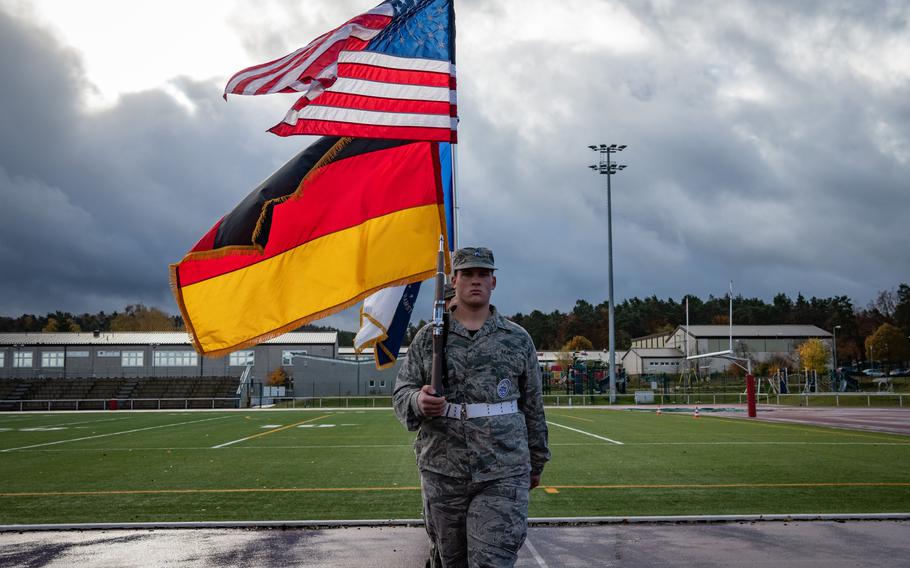
Air Force JROTC cadet Dorian Braun of Ramstein High School marches with a joint color guard at Kaiserslautern High School in Vogelweh, Germany, Friday, Nov. 10, 2023. (Phillip Walter Wellman/Stars and Stripes)
JROTC nurtures military interest
Air Academy seniors started their October JROTC class on their own, calling the class to a perfect silence, taking attendance and marching themselves out for a field day.
“There’s no other program that gives them the leadership opportunities in high school like this,” said retired Col. Robert Huber, who leads the large program. It’s drawn 270 students, well above the average of 80 to 100, he said.
While about a fourth of his students will go on to enlist or commission, his mission is to teach them citizenship, character and leadership.
The Air Academy program also fosters interest in pilot training through its curriculum that covers both the history and mechanics of flying. The program also ensures cadets are aware of the national JROTC scholarships that can allow high school students to earn their private pilot licenses.
Cadet Owen Chang spent eight weeks earning his private pilot’s license from Delta State University in Mississippi, where he was one of 13 students in his class.
“It’s probably one of the best summers of my life,” he said.
He has applied for an ROTC scholarship and hopes to commission as an officer and fly aerial tankers.
Over 16 years, more than 150 Air Academy JROTC students have gone on to college commissioning programs and 42 have gone on to service academies, Huber said.
Senior Josh Baker is among the cadets planning to enlist in the Air Force after high school. He had always loved military movies, and JROTC stoked that interest.
It also prepared him well for the physical test the Air Force requires. The cadets practice to increase the number of pushups and situps they can complete in a minute and running a mile, which mirrors the Air Force’s physical fitness test, he said.
Baker wants to become an electrician because he loves working with his hands, and he is hopeful the Air Force will give him the foundation for a career, potentially as a general contractor.
“Once I got into the program, I kind of fell in love with it,” said Baker, who attends Liberty High School and drives to Air Academy for JROTC.
© 2026 The Gazette (Colorado Springs, Colo.).
Visit www.gazette.com.
Distributed by Tribune Content Agency, LLC.
STARS AND STRIPES VIDEOS
AROUND THE WEB
STRIPES TOP NEWS


