


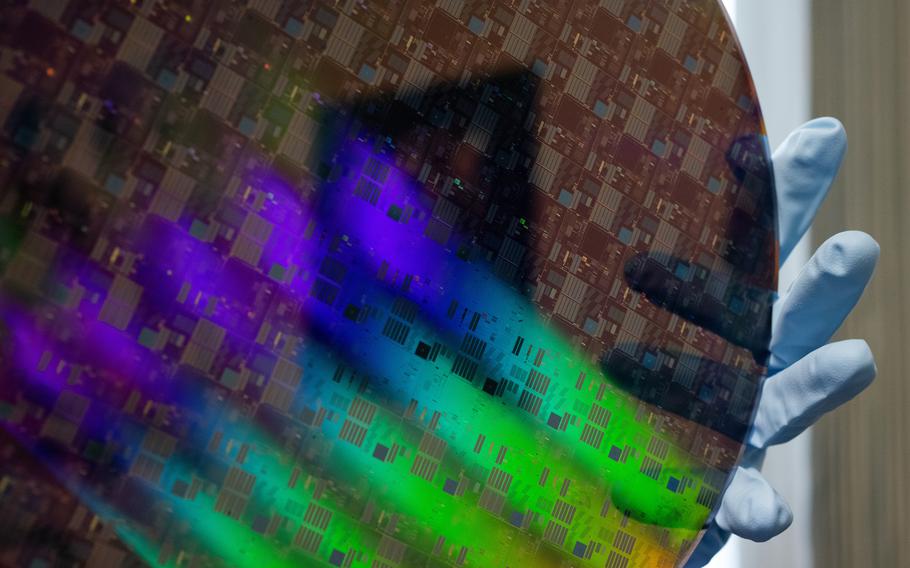
A silicon wafer. (Liesa Johannssen-Koppitz/Bloomberg)


ABOUT THE AUTHOR: Bob Dees, a retired U.S. Army major general, has a breadth of national security expertise, including development of high technology weapons and communications systems.
Earlier this year Huawei Deputy Chairman Eric Xu offered Washington an unusual compliment. “We are grateful to the U.S.,” he said, “for enabling our country’s semiconductor industry chain to truly grow.” When the leader of a firm that the Pentagon lists as a Chinese military company publicly thanks you for your strategy, it is time to reexamine your plan of attack.
That lesson should be front of mind this fall as Congress weighs provisions in the National Defense Authorization Act that would write new export restrictions on advanced AI chips into law and add new licensing requirements. But the NDAA is only the latest front in a larger debate about whether America wins the AI race by walling off its technology or by spreading it.
When the Biden administration turned targeted export restrictions into a sweeping cutoff of American chips, chipmaking equipment and expertise, it assumed China could not build what it could not buy. Instead, Washington handed Beijing a captive market and every incentive to fill it. Nvidia, which by its CEO’s account once held about 95% of China’s AI chip market, is projected to fall to roughly 8% by year’s end, with Huawei taking about half. This summer, meanwhile, China reportedly began producing its own advanced lithography machines, the very tools Washington worked hardest to deny it.
Any soldier understands the problem. You do not win by abandoning terrain and hoping the enemy declines to occupy it. By adopting draconian export controls, the Biden administration provided Huawei more than just an opportunity to replace Nvidia’s chips in China. They became the foundation of a broader effort to build an entire alternative AI ecosystem that Beijing now sells to the world.
The consequences are apparent in countries around the globe. For more than a decade, China’s Belt and Road Initiative has financed ports, railways and power plants across Asia, Africa and Latin America, buying influence wherever Washington was absent. Its “Digital Silk Road” applies the same playbook to telecommunications and now artificial intelligence.
In August, Huawei bid to build AI data centers for Egypt using its top-tier Ascend 950 chips, reportedly their first confirmed export. Brazil directed more than half of a $444 million AI investment to a supercomputing project built with Huawei and iFlytek. Across Africa, the Chinese model DeepSeek is spreading because it is cheap and available.
History shows how this ends. When Washington cut off Huawei from American chips and software, the company created its own kit and sold 5G equipment across the developing world. 5G networks carry far more than phone calls and whoever builds them is positioned to monitor or disrupt the data that flows across them. Restrictions did not stop Huawei from wiring much of the developing world, and AI infrastructure will matter even more.
Revenue from global sales funds the research that keeps American chips a generation ahead. Nations running AI on American technology also lets our country shape what AI becomes. Every nation that builds on China’s stack moves the world closer to AI that answers to Beijing.
President Donald Trump understands this. That’s why he rescinded the Biden-era rules that would have rationed American chips to much of the world, partners included. His approach preserves leading-edge chips for American innovators and trusted partners, while ensuring U.S. companies can still compete globally rather than cede markets to Huawei.
Congress has an important role to play in this effort. They must resist the urge to wall off American technology through rigid performance limits, sweeping bans, or new layers of approval for even older-generation chips. Chip technology moves too fast for fixed rules. Today’s cutting edge is tomorrow’s commodity, and a line drawn in statute can quietly harden into a blanket ban. Commanders need the flexibility to adjust as conditions on the battlefield change. So does a president working to keep America ahead of Beijing.
Trump should keep advancing an AI policy that protects America’s technological edge while putting American chips and standards in markets around the world, and Congress should give him room to do it. The nation whose technology the world builds on will set the rules for the AI future. The United States must continue to work to maintain that lead, and should not give Huawei any more reasons to say thank you.
STARS AND STRIPES VIDEOS
AROUND THE WEB
STRIPES TOP NEWS


