


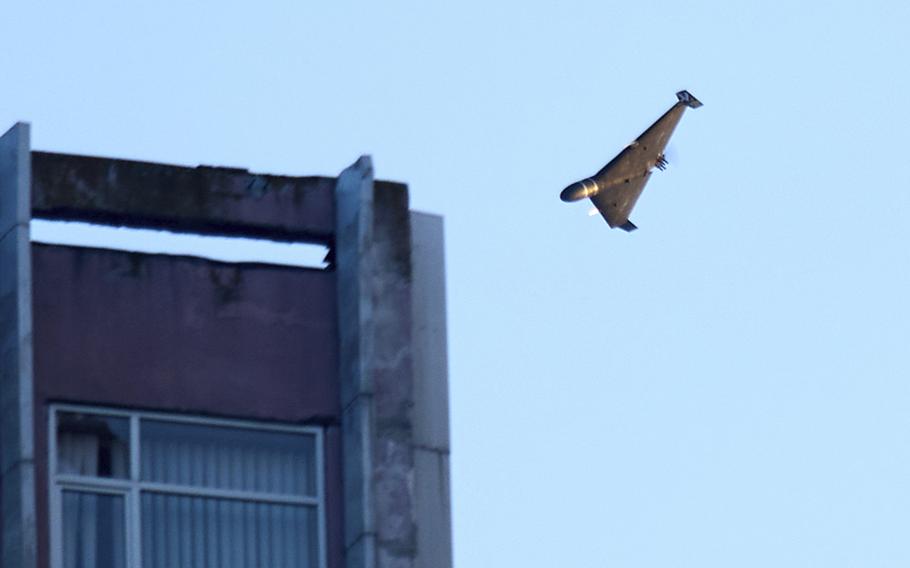
A Russian drone attacks a building during Russia's missile and drone air attack in Kyiv, Ukraine, June 17, 2025. (Efrem Lukatsky/AP)


ABOUT THE AUTHOR: David Zaikin is the founder and CEO of Key Elements Group, a London-based strategic consultancy specializing in defense and international affairs. He has written on defense procurement and drone warfare for the Jerusalem Post, Forbes and Stars and Stripes. He has also been featured in interviews with the BBC, Sky News and CNBC.
In the mid-1980s, Washington changed the way it supported the Afghan resistance fighting the Soviet Union. For years, the United States had helped the Mujahideen survive. Then it began helping them impose a much higher price on Moscow.
The turning point came in 1986, when Washington supplied Afghan fighters with Stinger anti-aircraft missiles. Soviet helicopter gunships had been one of Moscow’s decisive advantages. Suddenly, small groups of fighters on the ground could shoot them down. The Stinger did not bring down the Soviet Union. It did something more consequential: it changed the cost of the war.
Ukraine needs its own version of that strategy. This time, the decisive technology may not be a missile. It may be artificial intelligence.
The United States and Europe should give Ukraine privileged access to the most advanced Western military AI: computer vision, autonomous navigation, target recognition and edge computing. Ukraine is already showing why this matters. AI-enabled drones can navigate, identify and track targets, and keep functioning when Russian jamming disrupts communications.
Ukraine cannot win a simple contest of mass. Russia has more men, more artillery and greater industrial depth. Ukraine needs asymmetry: technology that lets a drone costing thousands destroy equipment worth millions.
The risk now is that the West moves cautiously while Russia adapts quickly. Ukraine has the battlefield experience, the engineers and the urgency. What it needs is faster access to technology that can turn those advantages into scale.
That was the logic behind Charlie Wilson’s war. Do not try to reproduce the adversary’s military machine. Identify the advantage on which that machine depends — and make it painfully expensive to sustain. There is another reason the comparison matters.
In 2017, Vladimir Putin told Russian schoolchildren that whoever became the leader in artificial intelligence would become “the ruler of the world.” He understood early that AI would become an instrument of national power. What he may not have understood was how poorly his own political system would accommodate it.
Russia has proclaimed technological sovereignty for years. The “Russian iPhone,” YotaPhone, disappeared after its maker went bankrupt. AI exposes the same weakness on a much larger scale: Moscow can call technology Russian, but it still depends on foreign chips, supply chains and engineering.
I grew up in the Soviet Union and left in 1990. The Soviet state understood the danger of uncontrolled information. Typewriters and photocopiers were restricted. The government did not fear the machines themselves. It feared what they enabled: people could copy something, circulate it and begin asking whether the official version was true.
Putin has rebuilt much of that instinct for the digital age. Russia blocks websites, pressures technology companies and increasingly interferes with the internet itself. The FSB has taken a larger role in controlling access.
AI presents the Kremlin with a different problem. A Russian who wonders what happened in Bucha no longer needs to know which opposition journalist to find or which banned website to trust. He can ask what happened, examine the evidence, compare the Kremlin’s account with satellite imagery and witness testimony, and keep questioning the answer.
And the underlying evidence is not ambiguous. The United Nations documented the killing of civilians in Bucha while the Ukrainian town was under Russian control and found strong indications that some summary executions may constitute war crimes.
That does not mean ChatGPT will bring down Vladimir Putin. It will not. But authoritarian information systems work best when satisfying curiosity is difficult, inconvenient or dangerous. AI lowers the cost of curiosity. It makes it easier for an ordinary person to move from a vague doubt to a specific question and from a specific question to evidence.
For decades, Russian propaganda has relied on more than persuading people that the Kremlin is telling the truth. Often it has been enough to persuade them that nobody is: that every source is compromised, every account is propaganda, and the truth is ultimately unknowable. An AI system that lets a user compare claims and request sources creates a different information environment.
That points to a Western strategy that only appears contradictory: make advanced AI expensive for the Russian state and cheap for the Russian citizen. Tighten Russia’s access to advanced semiconductors, high-end computing and the technologies needed to make its weapons more autonomous and lethal. At the same time, preserve ordinary Russians’ access to Western AI models, circumvention tools and independent information.
And in Ukraine, move in the opposite direction. Give Ukrainian engineers far deeper access to Western AI capabilities and the computing power to train, test and deploy them quickly.
Charlie Wilson’s strategy attacked one of Moscow’s advantages in Afghanistan. AI creates the possibility of attacking two today. On the battlefield, it can make Russian armor, artillery, command posts and electronic-warfare systems more vulnerable to inexpensive Ukrainian machines. Inside Russia, it can make Putin’s grip on information harder to sustain. One raises the cost of waging the war. The other raises the cost of lying about it.
Putin was right about one thing: Artificial intelligence is going to redistribute power. The West should make sure some of it is redistributed away from him.


