


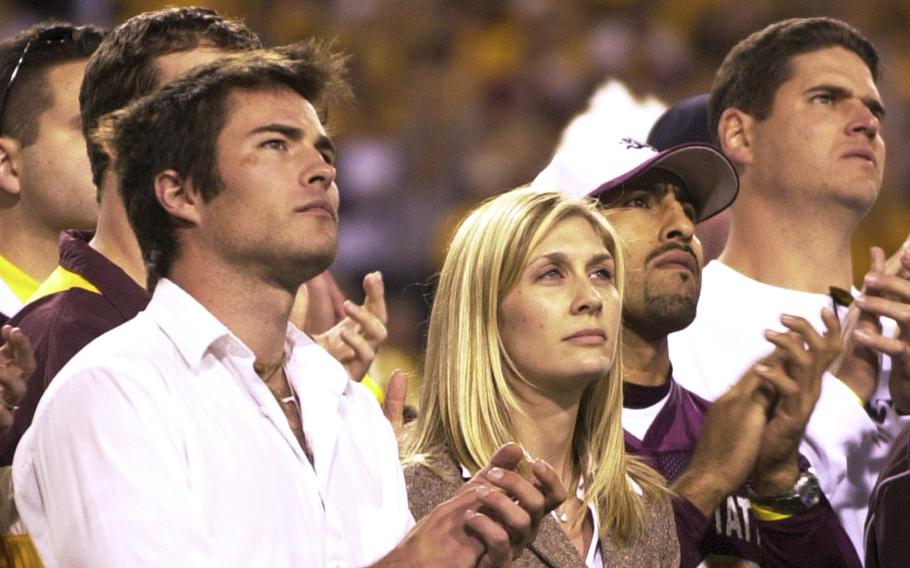
Former Arizona State player Pat Tillman's wife Marie Tillman, center, and his brother Richard Tillman, left, applaud as they watch Pat's name and jersey number enshrined in the university's ring of honor during halftime ceremonies between Washington State and Arizona State, Nov. 13, 2004, in Tempe, Ariz. (Paul Connors/AP)


ABOUT THE AUTHOR: Shawn Banzhaf, a combat veteran of the U.S. Army, is executive director of the Pat Tillman Veterans Center at Arizona State University. An author, speaker, and advocate for veteran post-traumatic growth, he oversees transition, academic and community support programs for over 25,000 military-connected students, veterans, spouses and dependents across ASU’s campuses and online programs.
For decades, American higher education has rallied around a well-intentioned label: “veteran-friendly.” Across the country, institutions have proudly displayed it on recruitment brochures, designated dedicated campus spaces, and streamlined GI Bill processing. These were vital first steps.
But in 2026, the landscape of military transition demands an evolution. Being “veteran-friendly” can no longer be a passive designation that treats transition as a simple administrative transaction; it must become an active commitment to a profound life shift. To truly honor military sacrifice, the standard of higher education support must move beyond expectation — starting with how institutions serve the entire military family unit.
Nationwide data reveals a systemic challenge that higher education must collectively address: veteran transition cannot be viewed through an isolated, single-student lens. Currently, 37% of part-time and 16% of full-time military-connected student service members and veterans drop out within their first nine months of enrollment. When a service member raises their right hand, their spouse and children serve right alongside them, enduring deployments, frequent relocations, and quiet sacrifices. Because the family is the primary support system keeping a veteran enrolled, institutions can drive student success by wrapping support around the whole family unit — streamlining Chapter 33 transfers, Fry Scholarships, flexible online degree paths, and on-campus work-study opportunities. Investing in military families does more than improve retention rates; it elevates entire communities.
Higher education can also work together to improve the transition timeline. Traditionally, the academic ecosystem has adopted a reactive posture, waiting for veterans to arrive on campus after separation — often after months of navigating complex Department of Veterans Affairs benefits, career uncertainty, and identity loss alone. A proactive approach is far more impactful. By engaging active-duty personnel 12 to 18 months before discharge, institutions can demystify GI Bill transfers, vocational rehabilitation, and degree mapping while service members are still in uniform. This builds clear, seamless bridges into high-tech engineering, cyber technology and business fields long before separation anxiety sets in.
Finally, the entire sector must shift from passive support to active workforce alignment. Handing a veteran a degree without a clear career pathway misses a crucial opportunity. Veterans do not lack capability; they often just lack a civilian translation of their skills. Higher education has a collective responsibility to build structured pipelines that combine academic rigor with corporate partnerships, internships, and peer mentorship, translating battlefield leadership into civilian industry excellence.
At Arizona State University’s Pat Tillman Veterans Center, we view this not as an administrative burden, but as a shared moral imperative. Serving over 25,000 military-connected learners, including more than 6,000 spouses and children, has shown us the immense potential of this approach. We have found that when an institution replaces passive compliance with an active, family-wide support model, outcomes naturally push beyond expectation.
The State of Arizona has modeled what is possible when public universities, community colleges and state leaders build a collaborative ecosystem dedicated to military families. This is a framework that can be scaled across the nation.
Military families have given this country their absolute best. By working together to raise our collective standards, America’s universities can move past simply checking boxes and establish a new national baseline of support that truly goes beyond expectation.


