


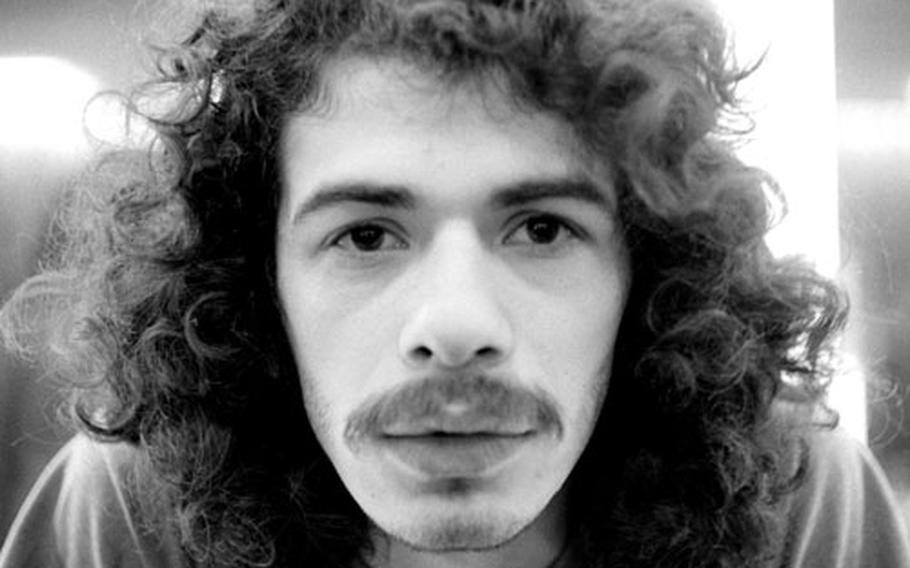
Carlos Santana poses for a photo backstage at Frankfurt, Germany, in 1971. (Bruce Johnson / Stars and Stripes)


LIKE THEIR MUSIC, the seven members of the pop group "Santana" are startling, complex and spaced out.
The music is a sophisticated fusion of Latin and African rhythms with American blues that converge in a feverish climax of emotion; the musicians are a strange breed of congenial; sensitive men who float in a surrealistic dimension of frivolity and fantasy.
Many musicians move in their own world surrounded by a buffer zone from the hassles of life, but the members of Santana are deeper in their own world than most.. They live for the music, everything else has importance only if it relates to their playing. The commitment, to "The Band," as they refer to each other, is total and unqualified
After West Coast success, Santana’s popularity rapidly expanded. Their first album, "Santana," has been on the charts for 84 weeks with sales over two million. The second album, "Abraxas," has been one of the 10 best-selling LPs for 27 weeks.
Future plans include the release of a now single, "Jungle Strut," and their third album in July.
SANTANA’S performance is a sharp contrast from their off-stage antics and seeming ineptness.
Lead guitarist Carlos Santana — frequently confused with organist Gregg Rolie — often talks about the street people, the "real teachers" as he calls them. "If you watch the street people with an open mind you learn and keep on growing," says Carlos.
Musically that couldn’t be more true.
The freshness and originality of Santana has evolved into a sound which in two years has thrust the group to the forefront of the music scene. Performances are an emotional explosion of rhythmic feeling that penetrates and overwhelms in a quasi-religious experience.
As Santana says: "Music is a way of knocking down the walls within us ... it directs frustration into the performance."
"Everything we do is directed toward ’The Band’," says drummer Mike Shrieve, "it all comes out in our playing "
Yet Shrieve had asked only a few minutes earlier — while relaxing in his Frankfurt hotel room — "By the way, what city and country are we in?"
SANTANA MOVES in a floating miniature world of each other, their manager Stan Marcum, a few friends and groupies.
Jose Areas (conga drums, trumpet, timbales) speaks English with a heavy accent from his native Nicaragua. The short, squat musician, who plays brilliantly, was hospitalized recently. Because of Areas’ problems, Escaeito Coke has joined the group temporarily as an additional timbales player.
The effect in concert with an eight-man Santana — instead of the six-man group that recorded their two albums — is an enrichment of their distinctive sound. Lead guitarist Neal Schon has played with Santana for about six months.
Coke got "burned" in Frankfurt. A Playboy bunnie-playmate he was friendly with in London had mailed a present. Optimistically he expected the best but the package contained 200 booklets of matches.
Carlos Santana, Mike Shrieve, Stan Marcum and conga player Mike Carrabello roared in laughter at the joke. One of the major crises in a tour by Santana is keeping a handy supply of matches.
THEIR LIFE is an eruption of acted-out fantasy, a constant high where, if they wish, reality is shunned. .
Details of living are handled by Marcum, a thirtyish ex-barber who directs their world. He makes sure the laundry is cleaned, interviews are avoided or arranged and generally takes care of the trivia most people cope with daily.
On stage the carefree attitude is replaced by concentration, and indifference changes to dedication. It is all together — the guitars, conga drums, timbales, and organ — in a tight instrumental package. The music is controlled, manipulated violence which mesmerizes the audience into movement with the beat.
Carlos Santana, Rolie, bass guitarist Dave Brown, and two others now departed first organized the Santana Blues Band five years ago in San Francisco. In 1969, Areas, Carrabello and Shrieve joined the group.
Even in the early days Stan Marcum was the manager and cut hair to help support the fledgling group. "I still enjoy cutting a few locks of hair now and then," he admitted in Frankfurt, "as long as it’s done with style."
Carlos Santana poses for a photo backstage at Frankfurt, Germany, in 1971. (Bruce Johnson / Stars and Stripes)

Seventeen-year-old guitarist Neal Schon backstage at Frankfurt. After his stint with Santana, Schon would gain fame as a member of Journey. (Bruce Johnson / Stars and Stripes)

Michael Shrieve and Carlos Santana. (Bruce Johnson / Stars and Stripes)

Carlos Santana talks with Michael Shrieve, whose performance with Santana at Woodstock at age 20 established his credentials as one of rock music's top drummers. (Bruce Johnson / Stars and Stripes)
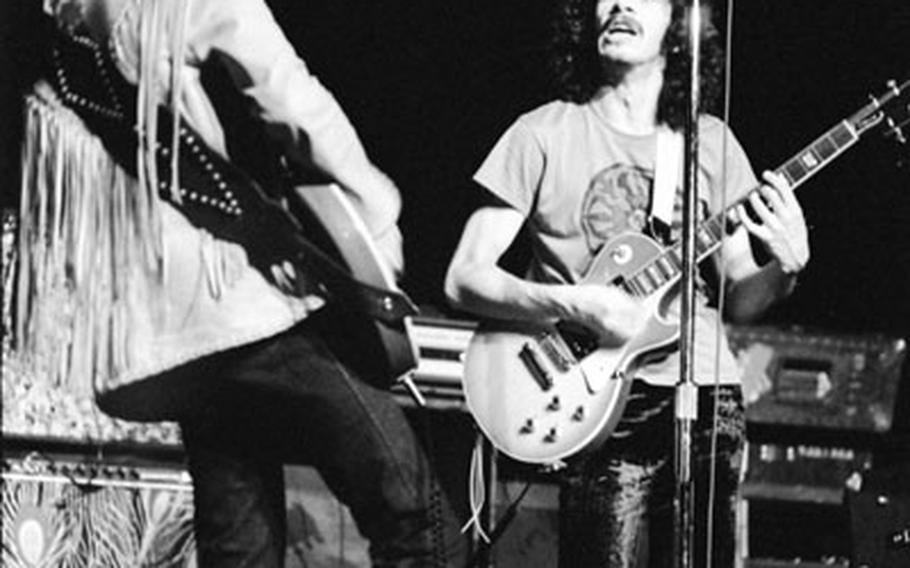
Neal Schon and Carlos Santana onstage at Frankfurt. (Bruce Johnson / Stars and Stripes)
STARS AND STRIPES VIDEOS
AROUND THE WEB
STRIPES TOP NEWS


