


A U.S. Navy F-35C Lightning II, attached to the “Salty Dogs” of Air Test and Evaluation Squadron 23, lands on the flight deck of future USS John F. Kennedy, marking the first F-35C landing on a Ford-class aircraft carrier. (Nolan Pennington/U.S. Navy)


The Navy’s newest fighter jet successfully landed and took off from its newest aircraft carrier, the Navy said Thursday.
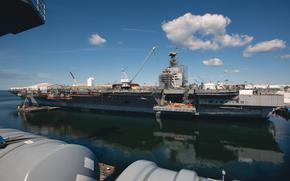
A F-35C Lightning II made a trapped landing and catapult launch on Tuesday aboard the future USS John F. Kennedy off the U.S. Atlantic coast.
“An F-35C Lightning II from the ‘Salty Dogs’ of Air Test and Evaluation Squadron (VX) 23 made the historic arrested landing,” the Navy said in a post on X.
The Navy has accepted the carrier from HII Newport News Shipbuilding in Virginia for testing before the planned commissioning of the second Gerald R. Ford-class carrier, scheduled for March 2027. The Navy refers to the carrier as the PCU John F. Kennedy, which stands for “Pre-Commissioning Unit.” The name will officially be changed to USS John F. Kennedy after it is commissioned.
The takeoff and landing marked the first time and F-35C has operated from the new class of aircraft carriers. Because of design limits on USS Gerald R. Ford, it operates older F/A-18 Super Hornets.
Congress mandated that the issues be resolved for John F. Kennedy, which has contributed to four years of delays from the original target delivery date in 2022.
The F-35C flown in the test is assigned to the Air Test and Evaluation Squadron 23 based at Naval Air Station Patuxent River, Md. The squadron is the Navy’s largest developmental flight test squadron.
The Navy plans to retrofit the Ford to operate the F-35C in the future. Currently, the F-35C can operate off some older Nimitz-class carriers.
The F-35C is the carrier-based variant of the Lightning II. The Air Force operates the F-35A, and the Marines fly both the F-35C and the F-35B, which has vertical and short takeoff and landing capability.
The Gerald R. Ford-class carriers use electromagnetic systems to launch aircraft and operate the elevators that move planes from internal hangars to the flight deck.
Citing delays caused by the new technology, President Donald Trump has called for future carriers of the class to return to using steam-driven catapults. The Navy plans to eventually build 10 Gerald R. Ford-class carriers to replace the Nimitz-class carriers that were commissioned between 1975 and 2009.

An F-35 test pilot from Air Test and Evaluation Squadron 23 flies an F-35C Lightning II fighter aircraft to the future USS John F. Kennedy in the Western Atlantic on Oct. 13, 2026. This is the first time an F-35C has landed on a Ford-class aircraft carrier. (Dane Wiedmann/U.S. Navy)

A U.S. Navy F-35C Lightning II, attached to the “Salty Dogs” of Air Test and Evaluation Squadron 23, is launched from the flight deck aboard future USS John F. Kennedy, marking the first F-35C launch on a Ford-class aircraft carrier. (Kaitlyn Bailey/U.S. Navy)

PREVIOUS COVERAGE
-
USS John F. Kennedy nearing acceptance as Navy’s second Ford-class aircraft carrier

-
USS John F. Kennedy completes last Navy tests before joining the fleet

-
Navy’s next carrier, USS John F. Kennedy, leaves shipyard for sea trials

-
Navy’s next carrier, John F. Kennedy, returns from first sea trials
-
Arrival of Navy’s second Ford-class carrier pushed back to 2027 in budget estimate

STARS AND STRIPES VIDEOS
AROUND THE WEB
STRIPES TOP NEWS


