


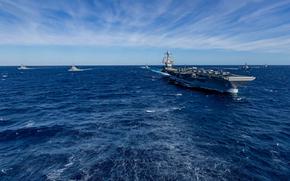
The future USS John F. Kennedy transits the James River near Norfolk, Va., as the ship departs for Builder’s Trials on Jan. 28, 2026. (Jayden Howard/U.S. Navy)


The future USS John F. Kennedy is 99% complete and nearing acceptance into the U.S. Navy’s fleet as the second nuclear-powered Ford-class aircraft carrier, the service announced Tuesday.
The Navy took “preliminary acceptance” Tuesday of the Kennedy after it completed successful acceptance trials in August, the sea service said in a news release. The ship’s crew will soon begin at-sea testing to build underway proficiency as its builder, Newport News Shipbuilding, completes the ship’s final systems.
“Achieving preliminary acceptance marks a new phase for the ship and her crew, allowing them to get more water under the keel as they test and train underway,” said Capt. Mark Johnson, the Navy’s program manager for Ford-Class new construction. “This milestone is a testament to the shared commitment of our sailors and our combined Navy-industry team, who remain laser-focused on completing the final stages of construction and test with precision and efficiency to deliver combat-ready lethality to the fleet.”
The Navy expects to take full ownership of the more than $11 billion ship in the spring, officials said.
The final step in the ship’s construction includes testing of the final four of the ship’s 11 advanced weapons elevators — electromagnetic-powered lifts for heavy munitions that can carry up to 24,000 pounds at a time, according to the Navy.
The Kennedy is nearly identical in size to the USS Gerald R. Ford at 1,092 feet long and 100,000 tons. The Ford, which was commissioned in 2017, is the largest and most technologically advanced current aircraft carrier in the world.
Newport News Shipbuilding began construction on the future USS Kennedy in 2011. It was initially supposed to reach the Navy by 2025, but it was delayed by supply chain issues and changes mandated by Congress. Those included changes to the advanced weapons elevators and the advanced arresting gear, which helps landing aircraft decelerate, according to Navy documents.
The Ford has served three deployments since its commissioning, including a historic 326-day sail from June 2025 to May 2026. That deployment saw the Ford operate in the Caribbean Sea in support of U.S. Southern Command’s Operation Southern Spear and later in the Red Sea, where it launched attacks against Iran-backed Houthi militants in Yemen who struck shipping vessels in the region and targeted Israel with drone and missile strikes.
The future USS Kennedy will be the second American aircraft carrier to carry the name of the 35th U.S. president, who was a Navy officer who saw combat in the Pacific in World War II.
The first USS John F. Kennedy served more than 40 years before it was decommissioned in 2007. The new USS Kennedy is expected to serve about 50 years, the Navy said.
PREVIOUS COVERAGE
-
USS John F. Kennedy completes last Navy tests before joining the fleet

-
Navy’s next carrier, USS John F. Kennedy, leaves shipyard for sea trials

-
Navy’s next carrier, John F. Kennedy, returns from first sea trials
-
Navy to spend $300M to prepare Naval Base Kitsap as a homeport for Ford-class aircraft carriers
-
1 sailor dead, 1 in custody following shooting aboard carrier John F. Kennedy


STARS AND STRIPES VIDEOS
AROUND THE WEB
STRIPES TOP NEWS


