


The Bell MV-75 Cheyenne II on display on Wednesday, Oct. 14, 2026, at the AUSA conference in Washington. (Eric Kayne/Stars and Stripes)


WASHINGTON — The Army’s first tilt-rotor aircraft will provide a massive leap in the service’s aviation capabilities when it arrives, its manufacturer said, but it is not yet clear when soldiers will receive the first MV-75 Cheyenne IIs.
The Army and Bell — the Texas-based subsidiary of Textron that is developing the MV-75 — faced a three-month communications blackout this year under a federal funding statute after fiscal year 2026 funding for the long-range, multi-mission aircraft ran out in July. Service and Bell officials this month renewed program communications and are working on a fielding timeline, said Frank Lazzara, Bell’s director of MV-75 sales and strategy.
“I can tell you we’re doing everything we can to find ways to do this, so the soldier gets their hands on it as quick as possible,” Lazzara said in an interview last week at the Association of the U.S. Army’s annual convention.
Army officials at one point suggested the first MV-75s could be delivered to the Army in 2030, but in January, then-Army chief of staff Gen. Randy George called for accelerating the production of the new aircraft, seeking to get the first Cheyennes to 101st Airborne Division soldiers at Fort Campbell, Ky., in 2028 or sooner.
With the budgetary problems, that will not happen, as the service is “no longer pursuing aggressive schedule acceleration beyond our already ambitious timeline,” Army spokeswoman Ellen Lovett said this week. Moreover, George was pushed out and forced to retire in April by Defense Secretary Pete Hegseth.
Budget concerns continue for Bell and the Army. The federal government is currently operating on a continuing resolution — a congressional agreement to fund the government at the prior year’s funding levels — through Dec. 11, and it appears unlikely lawmakers will pass a full federal budget before the end of the calendar year. A continuing resolution that lasts six months could “significantly delay the [MV-75] program,” Lovett said.
But if Congress can pass a timely budget — the Army requested more than $2.1 billion for MV-75 development in its fiscal year 2027 funding request — Lovett said the service can maintain a path to develop the Cheyenne more quickly than previous aviation platforms.
Last week, Bell displayed a mockup of the hulking aircraft — described as a 90% completed design with a complete cockpit and spacious rear cargo area — on the AUSA convention showroom floor. The Cheyenne will carry up to 14 troops and a crew of four. It will cruise at 320 mph and boast a range of up to 920 miles, dwarfing the 183 mph speed and 367-mile range of the Army’s workhorse UH-60 Black Hawk.

The Bell MV-75 Cheyenne II is displayed on Monday, Oct. 12, 2026, at the AUSA conference. The Cheyenne II is the Army’s next-generation, multirole, vertical-lift aircraft. (Eric Kayne/Stars and Stripes)
Lessons learned
Despite the budgetary bumps, Lazzara said Bell is moving ahead at pace with MV-75 production. Bell has opened production lines for building wings and other parts for the first three MV-75 prototypes. And it has begun testing the new aircraft’s gear box.
The Cheyenne is billed as a dramatic leap forward in tilt-rotor aviation, as Bell has gleaned the major lessons learned from the V-22 Osprey program since it was first fielded by the military in 2007. The Osprey, which has variants flown by the Marine Corps, Navy and Air Force Special Operations Command, was built by Bell and Boeing to provide the Pentagon with the ability to fly long distances like an airplane and take off, land and hover like a helicopter. That platform has faced problems that have contributed to fleet-wide groundings, low readiness rates and crashes.
But the MV-75 is an entirely new tilt-rotor aircraft, said Lazzara, who flew Army and Air Force helicopters before switching to piloting AFSOC’s CV-22 later in his military career. It is being designed to the Army’s specifications, which prioritize the ability to conduct air assault across vast distances — a technique Army officials believe is particularly important should military conflict arise in the Pacific region.
“Fundamentally, the way tilt-rotors work, it’s very similar,” Lazzara said. “But [the] major changes that you can see if you look at them side by side — [the MV-75 is] obviously designed to be an Army assault aircraft with side entry and exit. There are advantages to that.”
Other changes from the Osprey include fixed nacelles, which will keep the MV-75 engines in one place no matter which position their rotors are in. V-22 nacelles — and the engines inside them — move with the rotors, which have contributed to some 60% of Osprey maintenance issues, officials have said.
“The bottom line is … we’re taking the top 100 drivers of low availability for the V-22, and we’re going to make sure we correct them in this aircraft,” Lazzara said.
Perhaps the most important change, Lazzara said, is the MV-75’s open software system that will allow the Army to drive its own updates to the aircraft for years or decades of service. That Modular Open Systems Approach, or MOSA, software design and the MV-75’s fly-by-wire flight control system will also prepare it to potentially be flown autonomously, he said.
“It’s really exciting to talk about an aircraft, and it goes really fast, and it can go much further than a helicopter, and it looks cool. But equally as important in this program for the government is that open-systems approach and getting it right,” Lazzara said, calling the software design a close collaboration between Bell and Army officials. “Over the long haul, the life of this aircraft, the difference that could make compared to what we’ve seen in enduring fleets, is unbelievable with the upgradability and the speed of upgradability.”

The Bell MV-75 Cheyenne II on display on Wednesday, Oct. 14, 2026, at the AUSA conference in Washington. (Eric Kayne/Stars and Stripes)
Already preparing
The Army is already preparing for the MV-75’s arrival. Bell has helped develop flight simulator prototypes at Fort Rucker, Ala., and the company has enlisted Army maintainers to work through a virtual MV-75 simulator to help Bell engineers identify potential maintenance problems before designs are finalized.
At Fort Campbell, 101st soldiers have spent time in 2026 training with V-22 aircraft as the division’s leaders work to understand tilt-rotor capabilities and prepare their tactics to be ready for combat as soon as the first MV-75s arrive.
“To see the 101st getting ahead of that in a very effective manner … before they start taking aircraft on board, they’re going to learn lessons early, and it’s going to speed up their maturity and their progression when they do start getting those aircraft,” Lazzara said.
Army pilots will likely adjust easily to the new aircraft, Lazzara said, describing the MV-75 as a “very easy aircraft to fly.”
Lazzara said he was surprised after 14 years of flying helicopters how simple it was to transition to flying Ospreys. The biggest adjustment Army pilots will probably find is the added range, he said.
And, he added, he does not believe the new aircraft will force the Army to drastically alter its pilot-training pipeline.
“The actual fundamentals of flying a tilt-rotor are no more complicated than flying any other advanced aircraft, regardless of the configuration,” he said. “So, my very strong opinion is, no … [the Army] can do what they do now.”
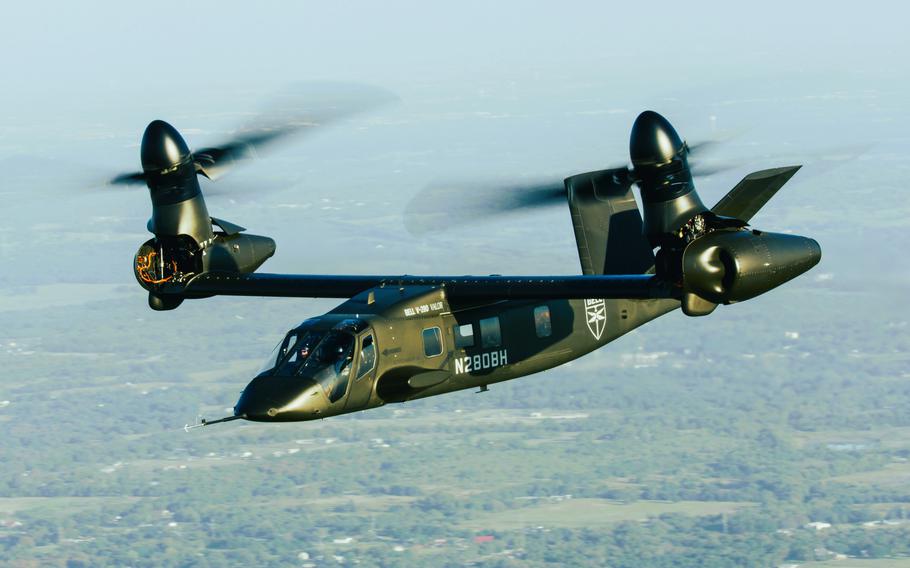
The V-280 Valor, a prototype of the Army’s planned MV-75 Future Long-Range Assault Aircraft that’s designed to replace the UH-60 Black Hawk. (Bell)
PREVIOUS COVERAGE




STARS AND STRIPES VIDEOS
AROUND THE WEB
STRIPES TOP NEWS


